
 Call Us Now
 e-Mail Us Now
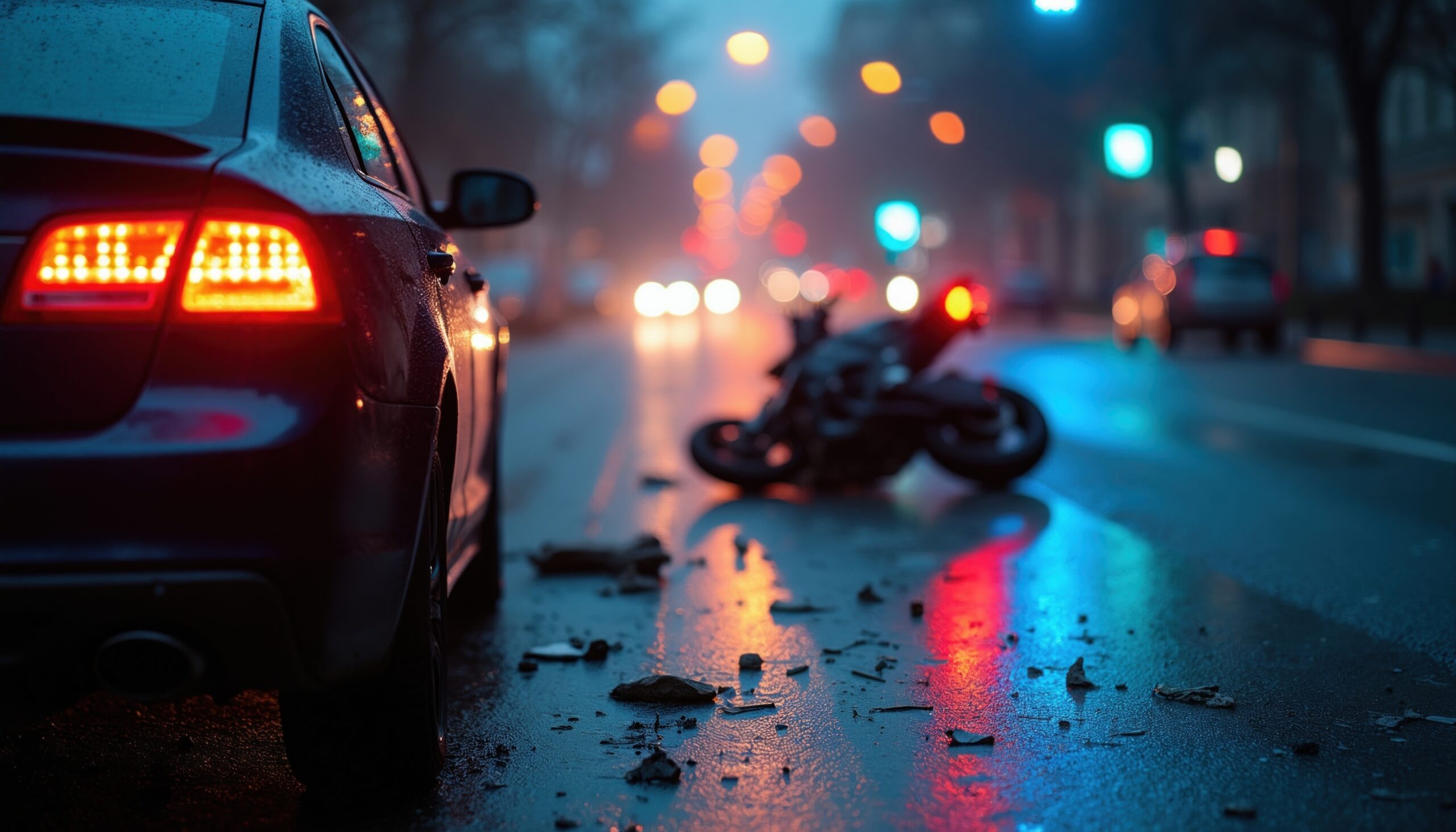
Most Florida drivers know the state runs on no-fault insurance. Your own policy pays your first medical bills, no matter who caused the crash. Riders assume the same rule protects them.
It does not. Florida’s no-fault system leaves motorcycles out entirely, and the gap catches riders at the worst possible moment. This guide explains why the law excludes two wheels, what your car policy will and will not do, which coverage actually pays after a crash, and how fault controls your recovery.
The No-Fault Law Skips Two Wheels
The exclusion comes from a definition, not from a special motorcycle rule. Florida Statutes Section 627.732 defines a motor vehicle, for no-fault purposes, as a self-propelled vehicle with four or more wheels that the state requires you to license for highway use. A motorcycle has two.
So the whole no-fault chapter simply never reaches your bike. There is no PIP requirement for motorcycles. There is also no real PIP product to buy for one. Some insurers sell a medical payments add-on that resembles PIP, but the no-fault statute does not govern it. Only the policy language does.
Your Car’s PIP Does Not Follow You Onto the Bike
This surprises riders more than anything else. You may carry a fully compliant auto policy with the full 10,000 dollars of PIP. That coverage still will not pay for injuries you suffer while riding your motorcycle.
PIP attaches to the covered vehicle and to occupants of that vehicle. Step off four wheels and onto two, and the coverage does not travel with you. Riders often learn this from an adjuster, weeks after the crash, with the first hospital bills already past due.
Florida Does Not Even Require You to Insure the Bike
Florida is unusual here. You can register a motorcycle without showing proof of insurance at all. No PIP, no property damage coverage, nothing.
The requirement arrives later, and only if you cause a crash. At that point Florida’s financial responsibility law expects you to show coverage of at least 10,000 dollars per person and 20,000 dollars per crash for bodily injury, plus 10,000 dollars for property damage. Riders who cannot show it risk losing their license and registration. So the state asks nothing up front and a great deal afterward.
That structure has a second effect worth knowing. Because the law never forces riders to buy coverage, a large share of motorcycles on Florida roads carry none. If another rider hits you, the odds of finding meaningful insurance on the other side drop sharply.
The Helmet Exemption Has an Insurance Catch
Florida lets riders 21 and older ride without a helmet, but only if they carry at least 10,000 dollars in medical benefits covering injuries from a motorcycle crash. Plenty of riders assume the PIP on their car satisfies that condition. It does not, for the same reason described above. PIP does not reach motorcycle injuries at all.
Check the declarations page on your motorcycle policy rather than your auto policy. If no medical benefit appears there, the exemption may not apply to you.
What Actually Pays Your Bills
Without PIP, a rider’s recovery depends on other sources. Usually several at once.
The at-fault driver’s bodily injury liability coverage is the primary target. Florida does not require drivers to carry it, though, which is a real problem in a state where roughly one in five drivers has no insurance at all. Uninsured and underinsured motorist coverage on your own motorcycle policy fills that hole, and for riders it is close to essential. Health insurance covers treatment, subject to your deductible and a possible lien later. A letter of protection lets a provider treat you now and get paid from the settlement.
The Injuries Are Worse and the Bills Arrive Faster
A rider has no cage, no airbag, and no crumple zone. The same impact that bruises a driver breaks bones on a motorcycle. Orthopedic surgery, road rash treatment, and head injuries all run into serious money quickly.
PIP exists precisely to cover that first wave of expense while fault gets sorted out. Riders skip that step entirely. Bills start arriving while the liability claim is still in its early stages, and no automatic benefit stands between you and collections. Sort out your payment path in the first week rather than the second month. Call your health insurer, confirm what the motorcycle policy includes, and ask your providers about a letter of protection before balances go past due.
Fault Controls Everything, and the 51 Percent Bar Applies
Because no-fault does not apply, a rider’s claim is a pure fault claim from day one. You prove the driver’s negligence or you recover nothing. Insurers know that riders start from this weaker position, and they price offers accordingly.
Florida also caps who can recover. Under Florida Statutes Section 768.81, anyone found more than 50 percent at fault for their own harm recovers nothing. At 50 percent or less, your award drops by your percentage. HB 837 created that bar in 2023, replacing the older pure comparative rule. Expect the defense to push your percentage toward the line, using arguments about speed, lane position, and visibility.
Florida Did Not Repeal PIP
You may have read that no-fault ended on July 1, 2026. It did not. Senate Bill 522 and House Bill 769 both died in committee when the 2026 session adjourned on March 13. PIP remains mandatory for cars, the 10,000 dollar minimum still applies, and the 14 day treatment rule still governs those claims.
None of that changes your position as a rider. Motorcycles sat outside the no-fault system before the repeal effort, and they sit outside it now.
Steps That Protect a Rider’s Claim
- Do not assume your auto PIP will pay anything toward a motorcycle injury
- Do not skip uninsured motorist coverage on the bike, given how many Florida drivers carry none
- Do not delay treatment while you wait to learn which policy pays
- Do not give the driver’s insurer a recorded statement about speed or lane position first
- Do not accept an offer that treats your gear or riding experience as evidence of fault
State-Specific Notes
The no-fault exclusion above is a Florida rule. Milano Legal Group also serves Arizona, California, and Texas, and none of those states runs a no-fault system for cars in the first place. Riders there pursue the at-fault driver from the start, exactly as Florida riders do. The fault standards differ, though. Arizona and California both apply pure comparative negligence, so partial fault reduces a recovery without ever barring it. Texas uses a 50 percent bar much like Florida’s.
How Milano Legal Group Can Help
Riders carry a harder claim than drivers, and they carry it without the cushion PIP gives everyone else. We identify every policy that could respond, including coverage riders forget they have. We document the driver’s negligence early, before memories fade. Then we fight the fault percentage the insurer assigns you by reflex. Learn how we handle rider injury claims on our motorcycle accidents page. You can also see our local practice on our Fort Lauderdale motorcycle accidents page.
We work on a contingency basis, so there are no fees unless we win. Call Milano Legal Group today at 855-545-1777 for a free, no-obligation case evaluation. Serving clients throughout Arizona, California, Florida, and Texas.


